Feature
Will Amsterdam Schiphol Airport’s future flights be clouded by Natura 2000 permit fight?
Recent court rulings on Schiphol’s nature permit leave both the Dutch government and the airport scrambling for solutions. Frances Marcellin finds out more.
Schiphol Airport is currently operating without a valid nature permit. Credit: Amsterdam Airport Schiphol
Back in 2023, Amsterdam Airport Schiphol (Schiphol) was granted a nature permit by the Minister for Nature and Nitrogen Policy, allowing for 440,000-500,000 flights. But in June 2025, the Hague District Court nulled the permit following lobbying from environmental groups about the impact on nearby Natura 2000 sites, which protect threatened species and habitats.
While Schiphol’s permit application was largely correct in identifying existing rights and aviation’s environmental impacts, it failed on the ‘additionality requirement’, which had been tightened after a Council of State ruling in December 2024.
Now operating without a valid nature permit – and effectively becoming a test bed for the Netherlands’ tightened nitrogen rules – questions are being raised about the potential legal risks that may occur during operations.
Why the nature permit was revoked
When examining how Schiphol ended up in this position, it’s vital to look at how the court can null the permit for not satisfying requirements that were adjusted after it was granted.
“The court refers in its verdict of 4 June 2025 to the so-called Rendac verdict of 18 December 2024 of the Administrative Jurisdiction Division of the Council of State; that Rendac verdict has a retroactive effect,” wrote the Ministry in an email when contacted about the case. “So it is understandable/explainable that the court holds Schiphol to standards that were introduced after their permit had already been granted.”
According to the Council of State, the Rendac verdict, which contested a 2020 nature permit covering the conversion of a steam boiler and the installation of a new biogas engine, reshaped Dutch nitrogen law by introducing a new assessment framework that applies immediately to all permits and retroactively to activities since 1 January 2020 – therefore impacting Schiphol’s nature permit agreement.

Until now, the conditions for internal offsetting were more flexible than for external offsetting.
Under the new rules, Schiphol can no longer simply balance nitrogen emissions against reductions elsewhere within the airport – known as ‘internal offsetting’ – at the early stage of review, but it must instead meet the same conditions.
“Until now, the conditions for internal offsetting were more flexible than for external offsetting,” states the Council of State. “This is changing with this ruling. The conditions are now virtually the same.”
To protect legal certainty, a transitional period until 2030 allows companies that relied on internal offsetting under the old rules to adjust their activities or seek new permits.
“The bigger issue,” wrote the Ministry, “is the question of whether compliance with these new standards/legislation is possible. Therefore, Schiphol and the State have filed an appeal to the verdict of 4 June 2025, in which the nature permit was annulled.”
What must be done to comply?
In the letter sent to parliament by Jean Rummenie, State Secretary for Agriculture, Fisheries, Food Security and Nature, two pathways are outlined. First, to comply with the additionality requirement, “a more detailed package of measures will have to be established”, for which further ecological research is required.
The alternative is a new decision using the ADC test, described as “very complex” and “not expected to provide a solution”. “The ADC test is a procedure applied when an appropriate assessment has shown that significant negative effects on a Natura 2000 site cannot be ruled out,” states the letter. “In such a case, a permit may nevertheless be granted if there is no alternative”.
The government also highlights broader implications, such as other projects that may also stall under the stricter rules, and suggests that the significant socio-economic interests of Schiphol justify an appeal. “Lodging an appeal is also considered desirable in view of the great socio-economic and societal interests involved in the operation of the airport.”
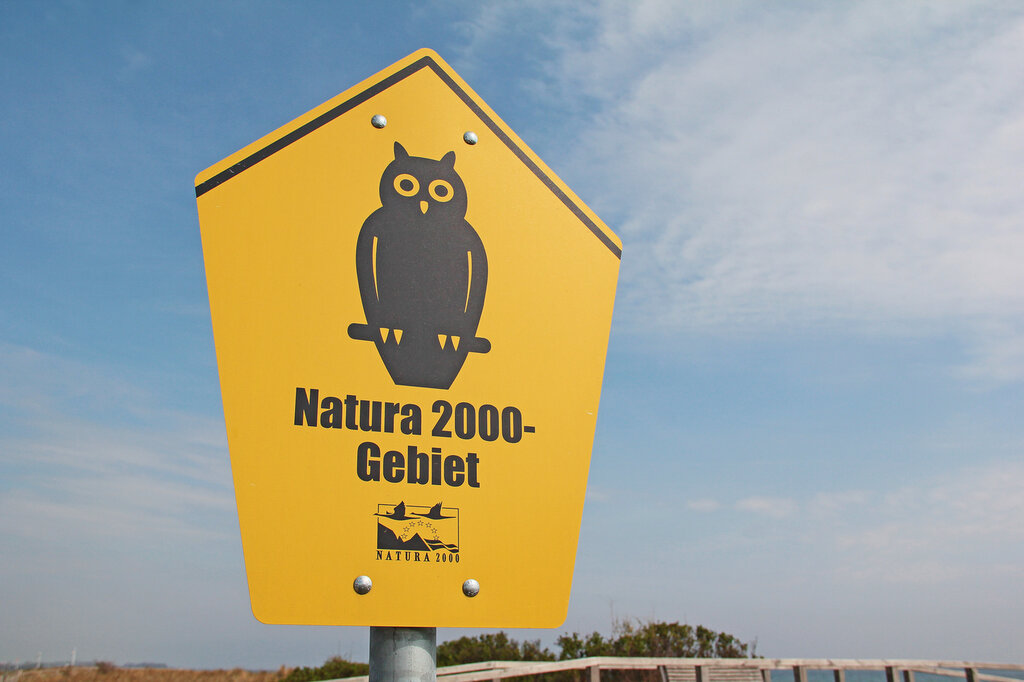
A sign denoting a Natura 2000 site. Natura 2000 is a network of nature protection areas in the territory of the European Union.
Schiphol’s current position
Schiphol stands by the claim that its permit application was mostly correct, failing only on the new additionality requirement. While the ruling has no short-term impact on flights, owners Royal Schiphol Group asked for the annulment to be suspended until the appeal was decided. However, on 4 September 2025, the Council of State rejected this request.
While the airport argued the annulment left its operations in legal uncertainty and warned that enforcement could have “disproportionate consequences”, the judge did not see it in the same way. The court acknowledged Schiphol’s need for legal clarity but found that the risks it described are not currently materialising.
Until now, the conditions for internal offsetting were more flexible than for external offsetting.
The court’s summary stated: “The interim relief judge does not consider the fear of the consequences of the district court's ruling outlined by RSG and the desire to avoid (enforcement) proceedings to be of such a compelling interest that it would require granting the request for interim relief.” As a result, the suspension request was denied.
An interim decision, the Council of State will hear Schiphol’s full appeal at a later date and issue a final ruling.
Schiphol will now face a new chapter in its nature permit battle. While it prepares to amend its application, the government seeks clarity on how to apply the tightened standards to its case. The final ruling will come after a hearing, for which the date is yet to be set, with the outcome potentially impacting flight capacity and setting a precedent for other airports across the country.
