Company Insight
Sponsored by Avlogix
Designing the Future of Baggage Handling – AvLogix Solutions’ Role in Creating Future-Ready Terminals
AvLogix Solutions’ Role in Creating Future-Ready Terminals.
Main image credit:
AvLogix Solutions has rapidly emerged as a trusted global partner in airport logistics design and planning. Starting in Australia, the company’s reach now extends across APAC, the Middle East, the US and Europe, where it has earned recognition for its expertise in baggage handling systems (BHS), cargo logistics and terminal operations.

Christian Riegman, AvLogix Solutions’ Director,
With major projects spanning from Australia to Dubai and San Francisco, AvLogix has become known for delivering innovative, future-focused solutions that help airports operate efficiently today while preparing for tomorrow’s demands.
Airport Industry Review spoke with AvLogix Solutions’ Director, Christian Riegman about the company’s rapid growth, how baggage handling is evolving, and what airports can do to be truly future-ready.
Airport Industry Review: AvLogix is a relatively young company, yet you’ve made a name for yourselves very quickly. What’s behind that?
Christian Riegman: Honestly, it comes down to focus and trust. We live and breathe aviation logistics, especially baggage handling, cargo and freight processing. That laser focus means we bring real technical depth to every project.
But the other part is the way we work. We collaborate closely with airports, operators and engineering firms to find solutions that really work on the ground. That approach has built long-term partnerships with clients who know we’ll stand alongside them throughout the process.
And then there’s the financial side. Airports need not only clever designs, but systems that make sense in terms of capital spend, operating costs and long-term return on investment. Every decision we make is tested against those three levers.
Airport Industry Review: Baggage handling hasn’t always been seen as the most innovative part of an airport. Is that starting to change?
Christian Riegman: For years, baggage technology lagged behind industries like logistics, e-commerce or manufacturing. Many airports were advised to stick with the “safest” options, which often meant staying with the familiar rather than adopting proven new ideas.
But this is changing. More and more, when we sit down with airports and show them what’s possible - advanced automation, automated bag storage, real-time bag tracking, semi-automated/robotic solutions, autonomous vehicles, digital twins, AI-driven optimisation - they see how these tools can improve reliability, cut costs and give passengers a better experience. Once the value becomes clear, the appetite for innovation really takes off.
Airport Industry Review: You’ve worked across different regions and industries. How does that help you bring fresh ideas into airports?
Christian Riegman: It’s one of our biggest advantages. Because we also work in logistics, cargo and other high-volume environments, we get to see how new technologies perform in the real world before they reach airports. That gives us confidence in recommending solutions that aren’t “experimental” but already tested at scale.
Airport Industry Review: Airports are often working towards big long-term masterplans. How do you make sure what your design today doesn’t box them in tomorrow?
Christian Riegman: That’s always front of mind. We look at both current needs and the bigger vision - where passenger and cargo volumes are headed, how technology trends might change operations and what the airport ultimately wants to become.
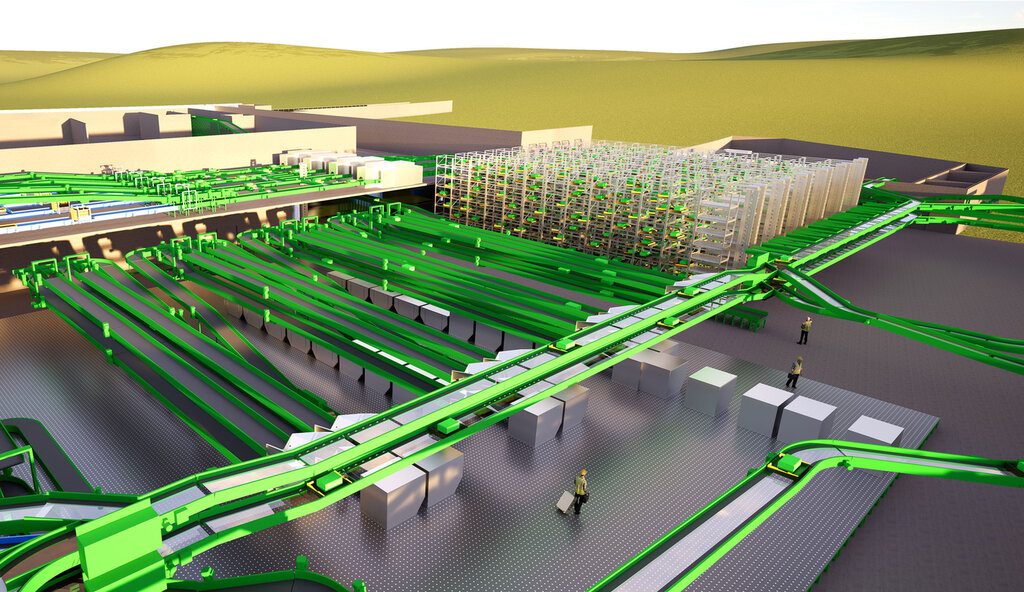
From there, we design with flexibility built in. That means modular systems that can be expanded later, layouts that anticipate growth by coordinating building elements with our designs to ensure they compliment the terminal expansion plans.
There is so much happening in the industry with enabling passengers to have more control over their travel journey. Bag storage enables much of this by accepting baggage earlier (even the day before or longer), facilitating 3rd party and courier delivery and collection of baggage, as well as allowing passengers the flexibility to choose when and where they pick up their baggage. Even IATA is now documenting airport operations to help facilitate decentralised baggage processing models.
Airport Industry Review: Sustainability is another huge theme in aviation. What does that mean for baggage systems?
Christian Riegman: For us, it’s about smart design. That might mean shorter conveyor runs that use less power, energy saving technology built into the system or predictive maintenance that extends equipment life.
Old school thinking was for every motor and gearbox to be serviced at regular intervals but with smart sensors attached to many system elements we can leverage changes in heat, sound and power draw to signal when service is required. AI plays a part as well as it reviews the mountains of data to look for patterns in equipment types and modes of failure to suggest areas of review.
Airport Industry Review: Passenger numbers are climbing again and expectations are higher than ever. How do airports keep up?
Christian Riegman: Flexibility and collaboration are key. We are often asked to be involved early in the problem solving and concept design process with the airport planners so that the airport can produce a clear brief of spatial requirements to the broader design team to work with.
The design teams are using Building Information Modelling (BIM) software to coordinate the overall terminal design, and tools like digital twins and our advanced simulation platform are real game changers that let airports model scenarios, test “what if” situations, and plan capacity in a really agile way.
Airport Industry Review: Looking ahead, what gets you excited about the future of baggage handling?
Christian Riegman: For us, it’s the merging of the digital and the physical. Where every bag is tracked like a parcel, and predictive analytics can smooth out disruptions before they happen. All of that is happening now.
Our systems are capturing images of each baggage item at check-in. If the transport system loses baggage tracking, then the first means of reconciling is via the image. The long-term goal is for a ‘tag-less’ baggage journey, but this requires a ‘rising tide’ of development globally between ports.
We also foresee automation doing more of the heavy lifting, which enables a more inclusive and diverse workforce that can focus on passenger experience. While robotic loading is taking slow steps, semi-automated loading is racing ahead. Autonomous vehicles are bringing empty ULDs to the workface and taking full ones to and from the aircraft.
The exciting part for us is helping airports turn those possibilities into reality, designing systems that are future-ready but also deliver value today.
For airports thinking about the next step, our message is simple: the future is already here - the challenge is to design for it now. That’s where we come in.
For more information on AvLogix Solutions and how they are creating the future of Airport Baggage Handling Systems, please visit www.avlogixsolutions.com
Contact information
AvLogix Solutions
Suite G.06/45-50 Kent Road
Mascot, New South Wales,
Australia 2020
Tel.: +61 1300 737 931
Email: info@avlogixsolutions.com
Web: www.avlogixsolutions.com